
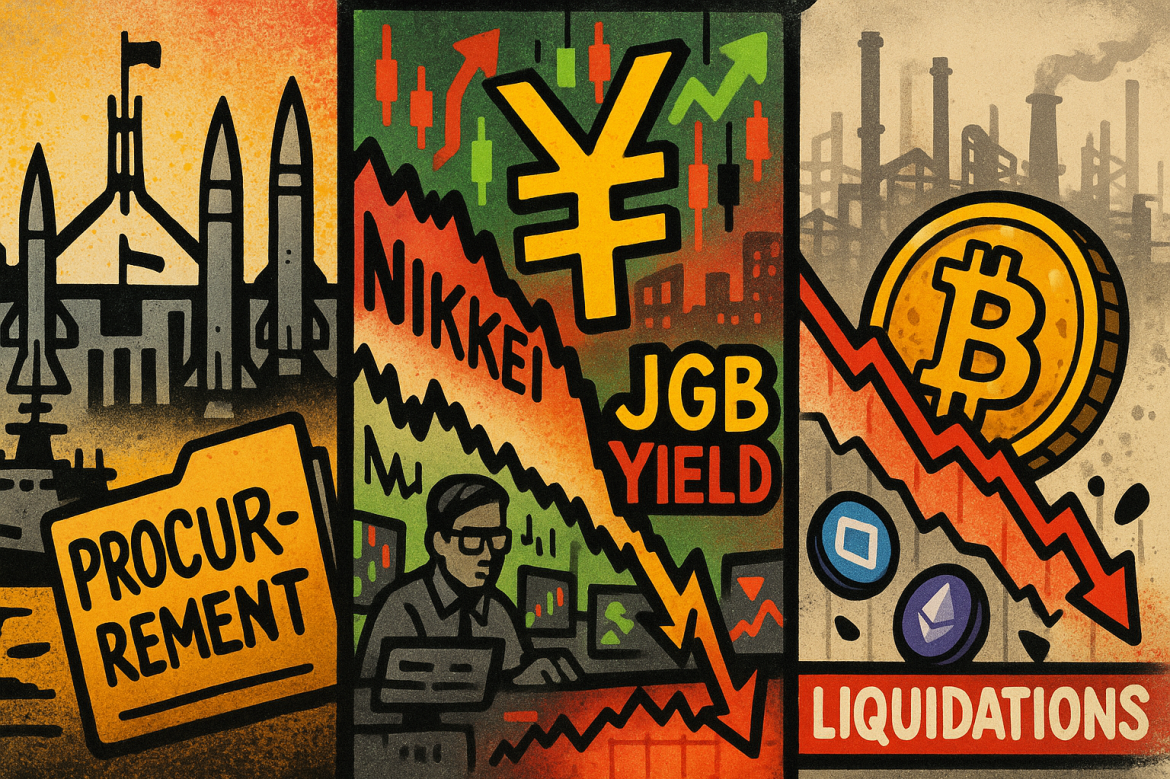
Morning brief: Australia to overhaul defence structure, Asian markets mixed
Australia, Asia and global macro sentiment opened the week on a cautious footing, with defence restructuring in Canberra, volatile equity moves across regional markets, renewed pressure in digital assets, and fresh signs of slowing momentum in China’s manufacturing sector.
Risk appetite weakened despite steady expectations of US rate cuts, while commodity and currency moves reflected a mixed and uncertain economic backdrop.
Australia’s defence department overhaul
Australian Defence Minister Richard Marles announced a major structural reform within the Defence Department, confirming that three existing groups will be merged to streamline operations and improve allocation of defence spending.
The Capability Acquisition and Sustainment Group (CASG), the Naval Shipbuilding and Sustainment Group (NSSG), and the Guided Weapons and Explosive Ordnance (GWEO) Group will be consolidated into a new Defence Delivery Agency.
The agency will commence operations on July 1, 2026, and is set to become a standalone entity a year later, on July 1, 2027.
It will be headed by a national armaments director and operate with autonomous reporting to both the defence and defence industry ministers.
Marles said the objective is to deliver “better bang for buck for the defense spend,” with the agency working in close partnership with the Defense Department and Australian Defence Force while retaining operational independence.
Asian markets slip as Yen strengthens and JGB yields spike
Regional markets began the week softer as risk aversion resurfaced following a strong end to November.
The Japanese yen strengthened to around 155.58 per US dollar after Bank of Japan Governor Kazuo Ueda signalled that the central bank would weigh the “pros and cons” of a rate hike at its next policy meeting, offering the strongest indication yet of a shift from ultra-loose policy.
The yen move pushed the Nikkei nearly 2% lower, while Japanese government bond yields climbed to 17-year highs.
The two-year JGB yield rose to 1.03%, its highest level since mid-2008.
Strategists noted that markets are still weighing the timing of a potential BOJ move, with traders interpreting Ueda’s comments as a sign that a rate increase this month is plausible.
Broader equity sentiment remained mixed.
S&P 500 and Nasdaq futures dipped 0.78% and 0.9% respectively in Asian hours.
Hong Kong’s Hang Seng, however, gained more than 0.35%, with the MSCI Asia-Pacific ex-Japan index falling 0.18% and staying on course for its strongest annual performance since 2017.
India’s Nifty 50 was up 0.15% and also hit a new all-time high in the session, buoyed by strong GDP data.
Bitcoin slides below $86,000 as deleveraging hits crypto markets
Cryptocurrency markets turned sharply lower, led by bitcoin, which extended its decline to fall below $86,000 on Monday.
The asset traded near $85,970, down 5.3% over 24 hours, erasing a five-day recovery above the $90,000 zone.
Ether, XRP and Solana also dropped between 5.5% and 7.6%.
More than $144 billion in crypto market capitalization was wiped out in four hours amid leveraged long liquidations, ETF outflows, and broader macro stress.
Bitcoin ETFs recorded $3.5 billion in outflows in November, while 180,000 traders were liquidated in a day, totaling $539 million, almost 90% from long positions.
The decline marks bitcoin’s weakest November since 2018, down 17.49% for the month.
Trading volumes softened across centralized and decentralized exchanges, with analysts citing a cooling of momentum and lower participation.
Key resistance now sits between $87,850 and $89,200, while downside risk remains toward $86,000 and below.
China manufacturing activity slips back into contraction
Fresh data showed renewed strain in China’s factory sector as the private RatingDog China General Manufacturing PMI slipped to 49.9 in November—below the 50 expansion threshold and under analysts’ expectations.
The reading reversed two months of growth and aligned with official PMI data, which has now shown contraction for eight straight months.
Weaker domestic demand offset strong export orders, while manufacturers cut staffing, scaled back purchasing and reduced inventories.
Analysts expect only a mild recovery in December as investment weakness and property decline continue to weigh on industrial output.
Retail sales, exports, and fixed-asset investment indicators reinforced a slower fourth-quarter trajectory, raising concerns that growth could dip below 4.5%.
The post Morning brief: Australia to overhaul defence structure, Asian markets mixed appeared first on Invezz