
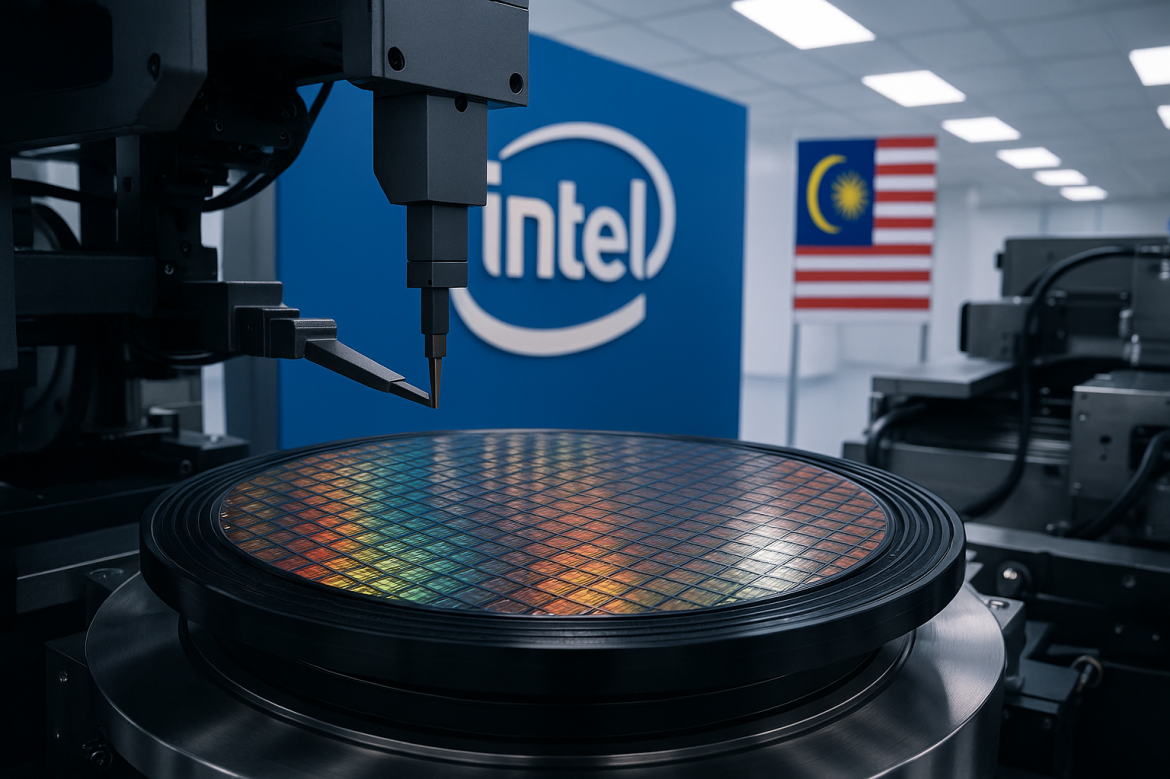
Intel expands Malaysia semiconductor operations with new investment boost
Malaysia’s position in the global semiconductor supply chain is gaining fresh momentum as Intel prepares another major expansion.
The company has confirmed a new 860 million ringgit investment, strengthening the country’s role in assembly and testing at a time when governments worldwide are competing to secure chip production capacity.
The announcement followed a meeting between Prime Minister Anwar Ibrahim and Intel chief executive Lip-Bu Tan, marking another step in Malaysia’s long-running partnership with the US chipmaker.
With global chip demand rising and nations pushing to build their own supply chain resilience, Malaysia is now working to anchor more advanced semiconductor activity on its soil.
Intel investment deepens Malaysia semiconductor ties
Intel’s latest commitment was revealed after the meeting between Anwar and the Intel chief on Monday, recorded in a Facebook post by the prime minister.
The new investment is intended to expand assembly and testing operations, which form one of the final and most technical stages of semiconductor production.
Anwar noted that Intel decided on the expansion due to confidence in Malaysia’s long-term industrial strategy.
The company already operates a major footprint in the country.
A 12 billion ringgit advanced packaging plant in Penang is nearing completion, with 99% of construction finished.
The site forms part of Intel’s existing commitments in the region, including a 2021 pledge of $7 billion to develop further facilities in Penang.
Malaysia strengthens chip packaging role
Malaysia handles around 13% of the global market for chip packaging, assembly, and testing.
These processes are essential for preparing completed semiconductor wafers for use in devices, and they serve as a significant pillar of Malaysia’s export activity.
Around 40% of national exports come from this sector, highlighting its central economic importance.
The government has been trying to expand this role even further as countries look to diversify and secure supply chains.
Recent geopolitical tensions and rising industrial competition have pushed nations to reduce reliance on single-country production hubs, creating an opening for Malaysia to promote itself as a stable base for advanced semiconductor work.
Global competition shapes semiconductor strategy
The push for more domestic chip capability is also accelerating in the US.
President Donald Trump’s administration continues to encourage American firms to invest more heavily on home soil, arguing that domestic production is essential for national competitiveness.
Policymakers have emphasised building a complete supply chain inside the US, although manufacturing costs remain significantly lower across Asia.
This broader environment has heightened the value of locations like Malaysia, where operational costs and long-established electronics ecosystems support large multinational players.
Intel’s renewed investment signals that the company sees Southeast Asia as an ongoing hub for a crucial segment of chip production.
Malaysia positions itself in shifting chip landscape
The latest commitment reinforces Malaysia’s effort to secure a stronger seat in the shifting semiconductor landscape.
As competition intensifies among major governments, the country is working to attract more high-value activity in advanced packaging and testing.
Intel’s additional investment highlights how established manufacturing bases continue to play a decisive role in global supply chains, even as nations attempt to localise more parts of chip production.
With its existing facilities, expanding capabilities, and strong export performance, Malaysia is aiming to convert current global pressures into long-term strategic gains.
The post Intel expands Malaysia semiconductor operations with new investment boost appeared first on Invezz