
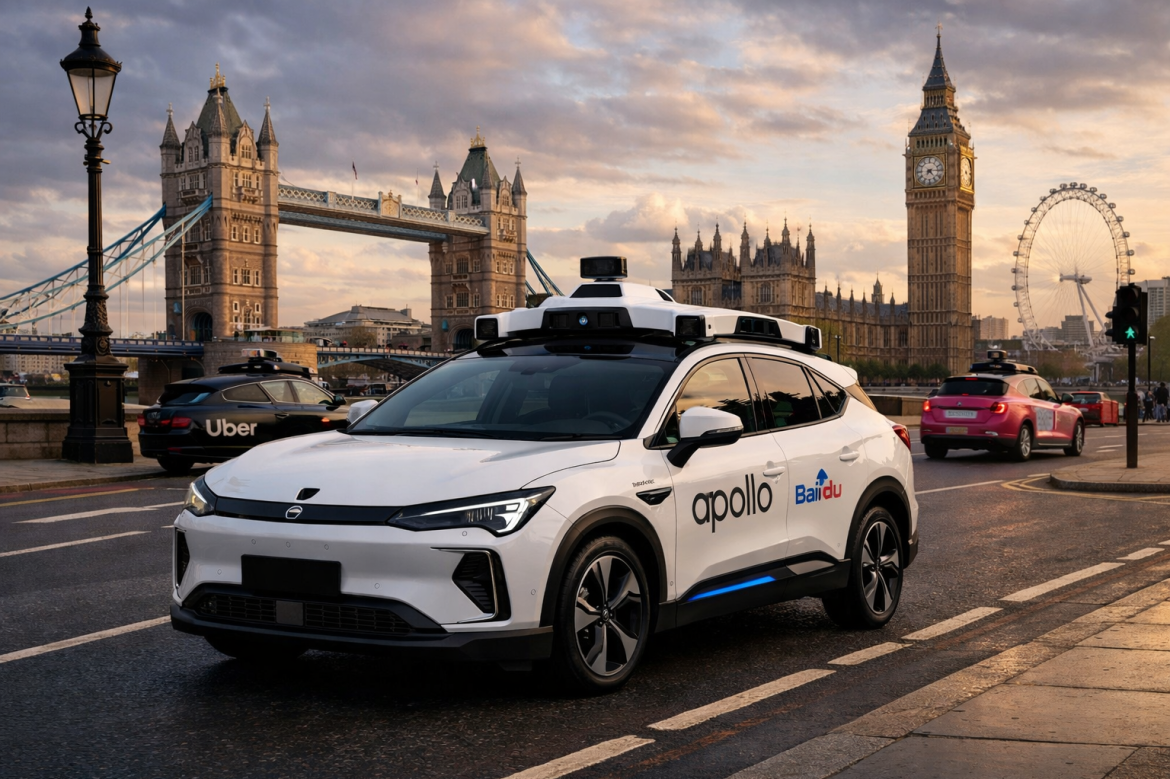
London is set to become the next testing ground for global autonomous driving firms after Chinese tech group Baidu confirmed plans to introduce robotaxis in the UK capital from next year.
The move, announced through partnerships with Uber and Lyft, places London at the centre of a fast-developing race to commercialise driverless transport.
The development follows recent UK government signals that it will move more quickly to allow autonomous vehicles on public roads, drawing interest from both Chinese and Western technology groups.
London chosen as the UK entry point
Under the proposed rollout, Baidu’s Apollo Go autonomous vehicles will be offered through the Uber and Lyft platforms.
Both companies confirmed the collaborations through posts on their social media accounts, signalling that ride-hailing apps will act as the consumer-facing layer for the robotaxi trials.
London is expected to host the first deployments, reflecting its status as a priority market for testing autonomous technology in dense and complex urban conditions.
Lyft said testing of Baidu’s initial fleet of dozens of vehicles is expected to begin in 2026, subject to regulatory approval. The company added that there are plans to scale the fleet to hundreds of vehicles over time.
The update was shared by Lyft chief executive David Risher in a post on X on Monday, outlining the potential size of the programme if approvals are secured.
Timelines set for Uber and Lyft pilots
Uber said that its first pilot involving Baidu’s robotaxis is expected to start in the first half of 2026.
The company indicated that the collaboration is designed to expand transport options for London users as autonomous vehicle technology advances, reinforcing the role of ride-hailing platforms as distribution channels for driverless services in major cities.
The London pilots are expected to operate within the framework of the UK’s evolving regulatory regime, which is being closely watched by autonomous vehicle developers seeking clarity on timelines and operating conditions.
UK regulation opens door to robotaxis
Interest in the UK has accelerated since the government announced in June that it would bring forward plans to allow autonomous vehicle technology on public roads.
Authorities now aim to permit robotaxis to operate in small-scale pilots from spring 2026, creating a clearer regulatory pathway for companies aiming to enter the market.
Baidu appears to be positioning itself to be among the early participants.
London’s wider transport policy also aligns with the arrival of autonomous vehicles.
The city has adopted a Vision Zero strategy that seeks to eliminate serious injuries and deaths across its transport network by 2041, with autonomous driving technology expected to contribute to long-term safety improvements.
Global competition intensifies in London
The planned UK entry builds on Baidu’s expanding international footprint in autonomous mobility.
The company says its Apollo Go service is active across 22 cities and currently delivers more than 250,000 weekly trips.
This places Baidu in direct competition with other Chinese developers such as WeRide, as well as Western rivals including Waymo, the self-driving unit of Alphabet.
Waymo is also preparing to begin testing in London, with a full service launch planned for 2026. It currently operates or plans to operate services in 26 markets worldwide, including Tokyo and New York City.
At the same time, Baidu has been expanding beyond China, with testing underway in international markets such as the United Arab Emirates and Switzerland, reinforcing London’s role in a broader global rollout strategy.
The post Baidu to bring robotaxi services to London via Uber and Lyft appeared first on Invezz